Climate Week NYC once again brought together leaders from across business, media, marketing and sustainability to discuss the opportunities and challenges shaping the transition to a more sustainable economy.
Throughout the week, Ad Net Zero participated in industry discussions on climate resilience, marketing effectiveness, measurement and behaviour change. We joined events hosted by Meta and the ANA Sustainability Marketing Forum, shared new research from the Sustainable Behaviours Ad Tracker with Kantar, discussed the progress and opportunities of the Global Media Sustainability Framework (GMSF) with industry leaders, and convened supporters and partners through our Climate Week Leadership Dinner.
Following Climate Week, Ad Net Zero US supporters came together to reflect on the conversations, themes and emerging priorities from the week. While discussions covered a wide range of topics, several themes consistently emerged.
The conversation is shifting from sustainability to resilience
One of the clearest themes was the growing focus on resilience.
Rather than talking exclusively about emissions reduction, many discussions centred on how businesses can prepare for increasing volatility, manage climate-related risks and strengthen long-term resilience.
For many organisations, climate change is no longer viewed solely as an environmental issue. It is increasingly being discussed in terms of business continuity, supply chain security, access to critical resources, and new opportunities for innovation and growth.
. This broadens the conversation and creates new opportunities to engage business leaders who may previously have viewed sustainability as separate from commercial priorities.
The business case continues to strengthen
Several attendees reflected that public discussion may sometimes suggest momentum is slowing. However, the conversations taking place across Climate Week painted a different picture, with many organisations continuing to embed sustainability into core business strategy.
While the language may be evolving, organisations continue to invest in sustainability initiatives because they recognise the commercial benefits, whether through efficiency, innovation, resilience, customer expectations or long-term value creation.
Behaviour change remains one of advertising’s biggest opportunities
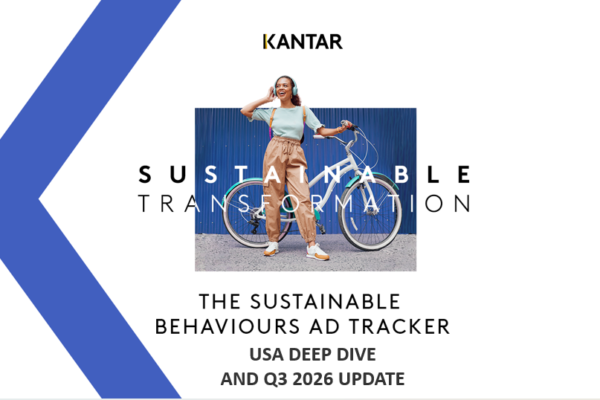
Climate Week also coincided with the release of the latest Sustainable Behaviours Ad Tracker from Kantar and Ad Net Zero.
The findings show that just 4.1% of ads globally feature sustainable behaviours, despite continued evidence from over 800 ads and counting that ads featuring sustainable behaviours outperform those with noneacross measures including distinctiveness, emotional engagement and likelihood of sharing.
While only 3.0% of US ads feature sustainable behaviours, audiences respond more positively to these ads than audiences in many other markets. US ads featuring sustainable behaviours delivered stronger gains in brand equity, sales likelihood, distinctiveness and viral potential than the global average, highlighting a significant opportunity for marketers.
This sparked wider discussion throughout Climate Week around the role advertising can play in helping consumers navigate change: to normalise behaviours that benefit consumers, businesses and society.
Rather than treating sustainability as a niche topic, many conversations focused on how advertisers and media owners care already making more sustainable choices feel relevant, desirable and accessible within everyday decision-making.
As the latest Kantar data demonstrates, advertisers do not need to choose between effectiveness and sustainability. The brands that are embedding sustainable behaviours into their advertising are already seeing the commercial benefits.
Measurement is moving from theory to implementation
Measurement remained a major area of focus throughout the week.
At the ANA Sustainability Marketing Forum, Ad Net Zero joined industry leaders to discuss how the Global Media Sustainability Framework (GMSF) is helping create greater consistency in media emissions measurement.
More broadly, conversations reflected a growing desire for practical tools and common standards that enable organisations to move forward in identifying savings in both cost and carbon as part of the regular planning process. The unlock is to ask calculator owners to add carbon values based on the GMSF into the decision dashboard.
What next?
- Download the latest Sustainable Behaviours Ad Tracker
- Explore the Every Brief Counts toolkit
- Learn more about AdGreen to improve the footprint of production
- Discover the Global Media Sustainability Framework (GMSF)
Get in touch with the Ad Net Zero team to find out how your organisation can get involved.