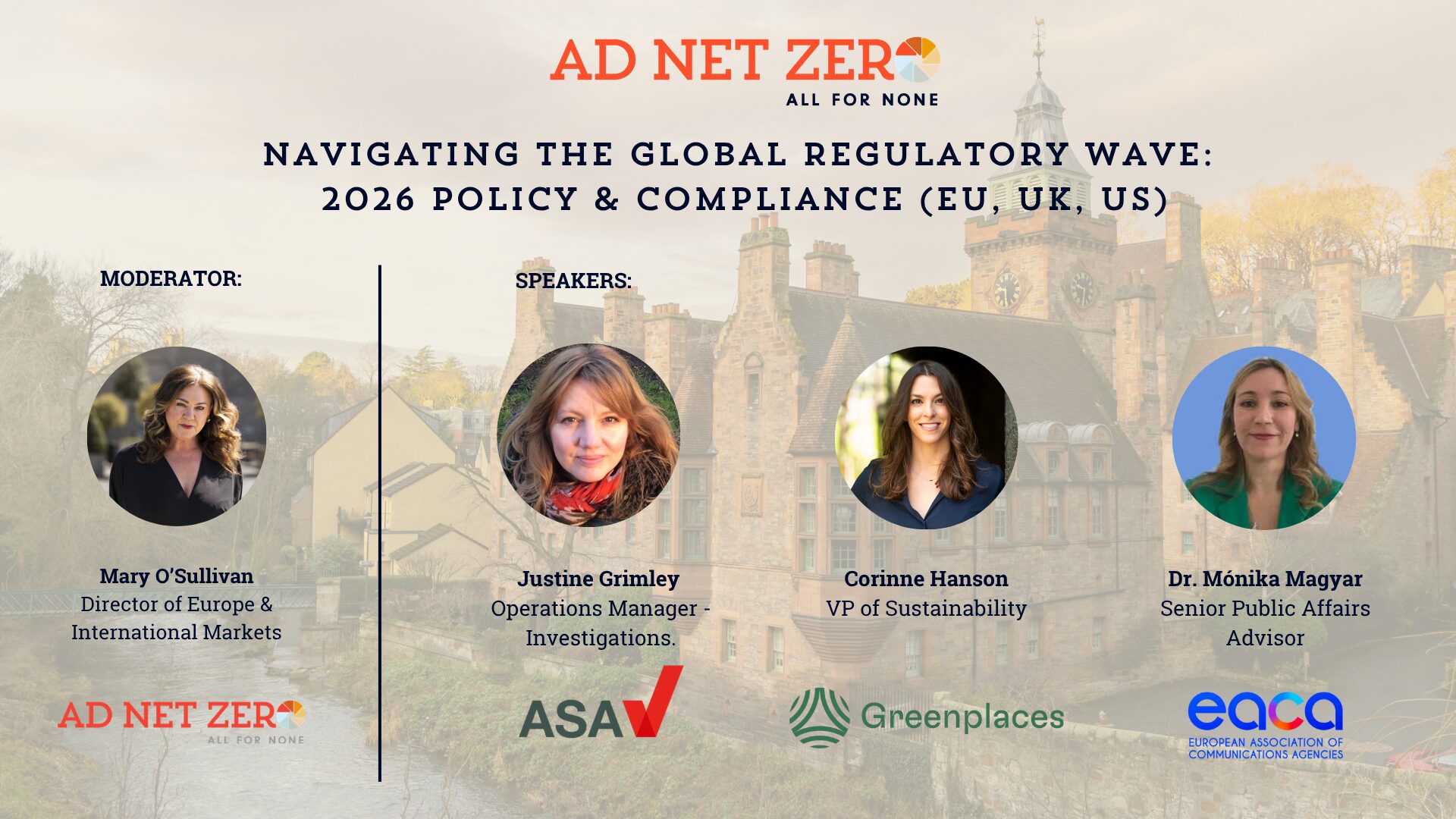
As climate-related regulation continues to evolve across the EU, UK and North America, Ad Net Zero brought together experts from Greenplaces, EACA and the ASA to help supporters understand what changing regulation means in practice for advertisers, agencies and media owners.
The session explored how businesses are now operating in a fragmented regulatory landscape, with increasing scrutiny on sustainability claims, reporting requirements and Scope 3 emissions. Speakers highlighted that while legislation continues to develop at different speeds across markets, the overall direction is clear: sustainability communication is moving away from broad storytelling and towards substantiated, evidence-based communication.
The growing pressure on sustainability reporting and disclosure
Corinne Hanson, VP of Sustainability at Greenplaces, opened the session by outlining the rapid increase in global ESG and sustainability regulation, with rules increasing by more than 150% over the past decade.
She highlighted how climate disclosure requirements are no longer confined to Europe, with countries including Brazil, Australia, Japan and Canada introducing climate disclosure rules, while California and New York continue to drive developments in the US market. California’s SB253 and SB261 regulations will introduce phased reporting requirements from 2026, including Scope 1, 2 and 3 emissions reporting and climate-related financial risk disclosure.
Beyond regulation itself, Corinne stressed that investor and client expectations are increasingly shaping the market. With 99% of the S&P 500 now reporting on ESG in some form, sustainability reporting is becoming embedded into procurement processes, supplier mandates and RFPs.
She warned against treating sustainability as a siloed workstream, explaining that businesses still relying on disconnected spreadsheets and isolated reporting systems face growing audit and regulatory risks. Instead, organisations need integrated systems where carbon data is treated with the same level of rigour as financial data.
Corinne outlined five key areas businesses should focus on building into their sustainability programmes: carbon accounting, assurance and controls, disclosure and reporting, supplier and client response systems, and governance and legal oversight.
From sustainability storytelling to substantiated communication
Monika Magyar, Senior Public Affairs and Legal Advisor at EACA, focused on the changing EU regulatory landscape and the shift towards substantiated communication.
While the proposed Green Claims Directive remains paused, Monika highlighted that the Empowering Consumers for the Green Transition Directive (EmpCo) is already moving towards enforcement from September 2026. The directive updates existing consumer protection law and applies across all consumer-facing marketing communications.
The session highlighted four key areas likely to face increased scrutiny under the regulation:
- vague environmental claims without proof
- carbon neutral claims based only on offsets
- self-created or unverified eco-labels
- future sustainability promises without detailed plans
Monika also stressed that visual communication falls within scope, meaning green imagery, leaves and nature-based branding can contribute to misleading impressions if unsupported by evidence.
Importantly, the regulation will apply not only to future campaigns, but also to existing websites, social content and marketing materials already in market by September 2026.
The session also explored common industry risks, including outdated claims remaining online, legal and creative teams working separately, and supplier sustainability claims creating knock-on exposure for brands repeating them in campaigns.
Monika also introduced the TEAL Helix project, a Horizon Europe initiative testing how sustainability communication works in practice. Early findings suggest that more sustainability information does not necessarily improve understanding or trust, reinforcing the importance of clear and accessible communication.
The ASA’s approach to environmental claims
Justine Grimley, Operations Manager for Investigations at the ASA, shared how the ASA is approaching environmental claims regulation in the UK.
The ASA’s work combines consumer research, partnership working, data science tools and formal investigations to identify high-risk sectors and emerging issues. Recent work has focused on areas including energy, transport, disposal claims, food and fashion.
Using examples from fashion advertising, including cases involving Lacoste, Nike and Superdry, Justine highlighted how advertisers often fall into difficulty with broad or absolute sustainability claims such as “sustainable style” or “sustainable clothing”.
A recurring theme throughout the session was that claims are judged on how the average consumer is likely to interpret them, rather than what advertisers intended the messaging to mean.
Justine also outlined several common issues advertisers should consider:
- ensuring the basis of claims is clear
- holding robust substantiation for objective claims
- considering full lifecycle impacts for broad sustainability claims
- making qualifications sufficiently prominent
- carefully explaining claims involving offsets or future targets
The ASA encouraged businesses not to avoid sustainability messaging altogether, but instead to focus on clear, accurate and evidence-based communication. Guidance, training and the ASA’s Copy Advice service were highlighted as practical tools available to support advertisers navigating this changing landscape.
Building trust through evidence-based communication
Across all three markets, the session reinforced that sustainability communication is entering a new phase, one where trust, substantiation and governance are becoming increasingly important.
As regulation evolves, sustainability messaging can no longer sit separately from legal, operational and reporting functions. Instead, businesses need stronger internal alignment, better data systems and communication that consumers, regulators and clients can clearly understand and trust.
Resources shared
Full recording: Available exclusively to Ad Net Zero supporters via the Supporter Portal.
Reports and frameworks
Tools and guidance