In our first of three webinars centring on the theme of Nature, we set out to establish a clear baseline: that nature is not a peripheral sustainability issue, it is foundational infrastructure for business resilience.
Beyond the Buzzword: Integrating Nature into Business for Resilience
16 February 2026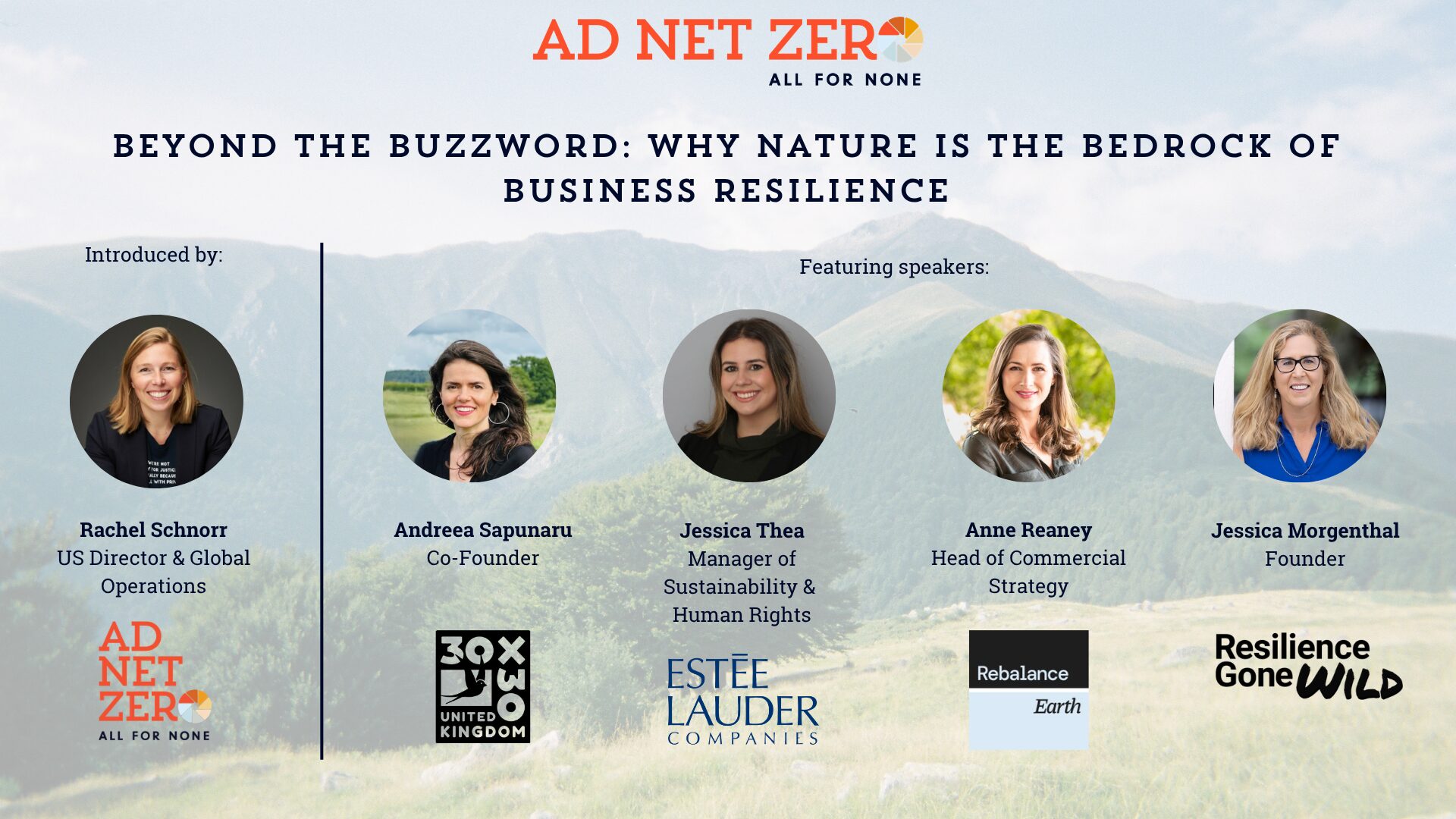
The level set on Nature
Andreea Sapunaru, ex Unilever & Co-Founder 30×30 UK, opened by translating ecological breakdown into business language. Referencing recent cocoa shortages that forced major brands to reformulate chocolate products to ‘chocolate flavoured’, she described it as “the canary in the coal mine. And this is what nature loss looks like in business terms.” Supply chain volatility, rising input costs, reformulation, and reputational risk are not abstract environmental outcomes- they’re all elements that will be familiar to sustainability and business experts alike, and ones that Nature plays a vital role in influencing.
Framing the science through planetary boundaries, the “safe operating space that our lives and economies depend on”, Andreea noted that seven of nine boundaries have now been crossed.
She also highlighted the 30by30 commitment – protecting 30% of land and sea for nature by 2030 – as the globally agreed solution framework, with nearly 200 countries signed on and early proof of success in Costa Rica’s large-scale forest restoration programs.
For the sceptics out there, Andreea offered an alternative viewpoint, one addressed in a recent report published by the UK Government, that identified global biodiversity loss and ecosystem collapse as a threat to national security. This framing shows how “this is no longer a fringe issue”, with one case study in the report showing how failing coffee harvest was driving migration from Central America to the USA. When ecosystem collapse means it’s no longer as simple as switching from one supplier to another- when you cannot just find another farm, net or factory, it leads to massive geopolitical risks.
Practical example of the dire needs for nature and for business
Anne Reaney, Head of Commercial Growth at Rebalance Earth, demonstrated how that shift can work in practice. “Our entire economy depends on nature,” she reminded the audience, but less than 1% of the world’s biggest companies mention nature in their annual reporting.
Looking to the UK’s Norfolk coastline, she illustrated how degraded ecosystems translate into economic fragility; declining fish stocks, supply volatility, and regional economic loss. For large food brands, pet food is often their most profitable division, and thus marine ecosystem decline presents a material business risk given fishing stocks are vital to their supply chain.
Tension between short-term and long-term
A recurring concern from webinar attendees was the tension between long-term ecological restoration and short-term commercial pressures. “Our clients usually prioritise short-term results,” one participant noted. Anne acknowledged this challenge, explaining that the business case must link nature action to immediate and near-term benefits wherever possible, such as flood risk reduction during high-risk seasons. She emphasised breaking nature action into milestones: public commitments, project identification, and measurable outcomes. “Celebrating wins all along the way is critical,” she said, reinforcing that resilience is built incrementally.
Communication emerged as another key lever. Referencing Potential Energy Coalition’s ‘Five simple shifts for climate communication in 2026’, attendees asked whether “nature language” offers a more compelling alternative. Andreea responded affirmatively: “Yes, because nature, unlike carbon, is tangible and emotional.” Nature provides a bridge; connecting ecological health with everyday experiences, from clean water to thriving landscapes.
As we know, the advertising and marketing industry plays an outsized role. As Andreea reminded participants: “Every campaign you create… teaches people what nature is.” The narratives brands construct influence whether nature is framed as extractable resource, aesthetic backdrop, or essential life-support system. More on the topic of Nature in storytelling in the final session of the Ad Net Zero webinar series, kicking off Earth Month on April 2nd.
Estee Lauder’s journey to integrated climate and nature planning
Jessica Thea of Estée Lauder Companies (ELC) offered insight into how a global beauty company is integrating nature into their corporate strategy, across governance, sourcing, water, and climate.
Historically, ELC’s work on responsible sourcing, water stewardship, and ESG commitments addressed nature indirectly. The shift in recent years has been toward explicitly understanding nature as a strategic risk and resilience issue, beginning with a nature materiality assessment across its value chain. From analysing ingredients, packaging feedstocks, and operational hotspots to applying tools such as the WWF Biodiversity Risk Filter and piloting the Science Based Targets Network (SBTN) methodology allowed them to map biodiversity pressures geographically and operationally.
Critically, Jessica emphasised the intersection of nature, climate, and water. Rather than treating biodiversity as a separate pillar, ELC is examining how these systems interact to shape enterprise risk. For a global beauty company reliant on agricultural inputs and water-intensive processes, ecosystem stability is directly tied to supply continuity, brand integrity, and regulatory exposure.
Resilience and the daily opportunity for each of us
Closing the session, Jessica Morgenthal of Resilience Gone Wild took the conversation from operational strategy to systems thinking. Resilience is not simply about bouncing back, it is about building adaptive capacity in interconnected systems.
The link to business is direct: organisational resilience mirrors ecological resilience. Companies that understand their dependencies, diversify risk, invest in regeneration, and think in systems terms are better equipped for disruption.
For the advertising industry, the opportunity is twofold: translate ecological risk into commercial logic and reshape the cultural stories that define value and progress. Resilience, in business as in nature, depends on recognising interdependence. And that begins with a shared baseline: nature is not outside the system. It is the system.
Achieving a comprehensive win for ourselves, our teams, our clients, our organization, and the natural world requires a steadfast alignment of purpose and action. Using nature stories as a masterclass in proactive design, Jessica shared a high-impact resilience practice to fuel the motivation needed to navigate the complexities of industry change. This ‘language nudge’ – transitioning from the weight of ‘I have to’ to the agency of ‘I want to’ – empowers individuals to re-frame their contributions with a heartfelt rationale, generating the sustained positive energy required to thrive in a systems-focused world.
Resources shared
Trailer: Why Nature is the Bedrock of Business Resilience
Full recording: Available exclusively to Ad Net Zero Supporters. Please log into your Supporter Portal or contact the Ad Net Zero team for access.
Reports
- Nature security assessment on global biodiversity loss, ecosystem collapse and national security – …
- Landmark 2019 IPBES Global Assessment Report on Biodiversity and Ecosystem Services that showed the state of biodiversity degradation: https://www.ipbes.net/global-assessment
Regulation
Tools
- Global Biodiversity Framework that the 30×30 target is part of: https://www.cbd.int/gbf/targets
Innovation